
How Smart Executives Are Actually Adopting Generative AI Inside the Enterprise
What Microsoft’s GenAI playbook reveals about AI strategy, product redesign, business model innovation, leadership alignment, and responsible AI adoption

CORE CONCEPT
Generative AI is not simply a technology upgrade—it is a strategic transformation that requires companies to rethink products, business models, leadership alignment, and organizational culture. According to Microsoft’s AI leadership, the greatest value from GenAI comes when organizations apply it to their hardest and most complex problems rather than incremental improvements.
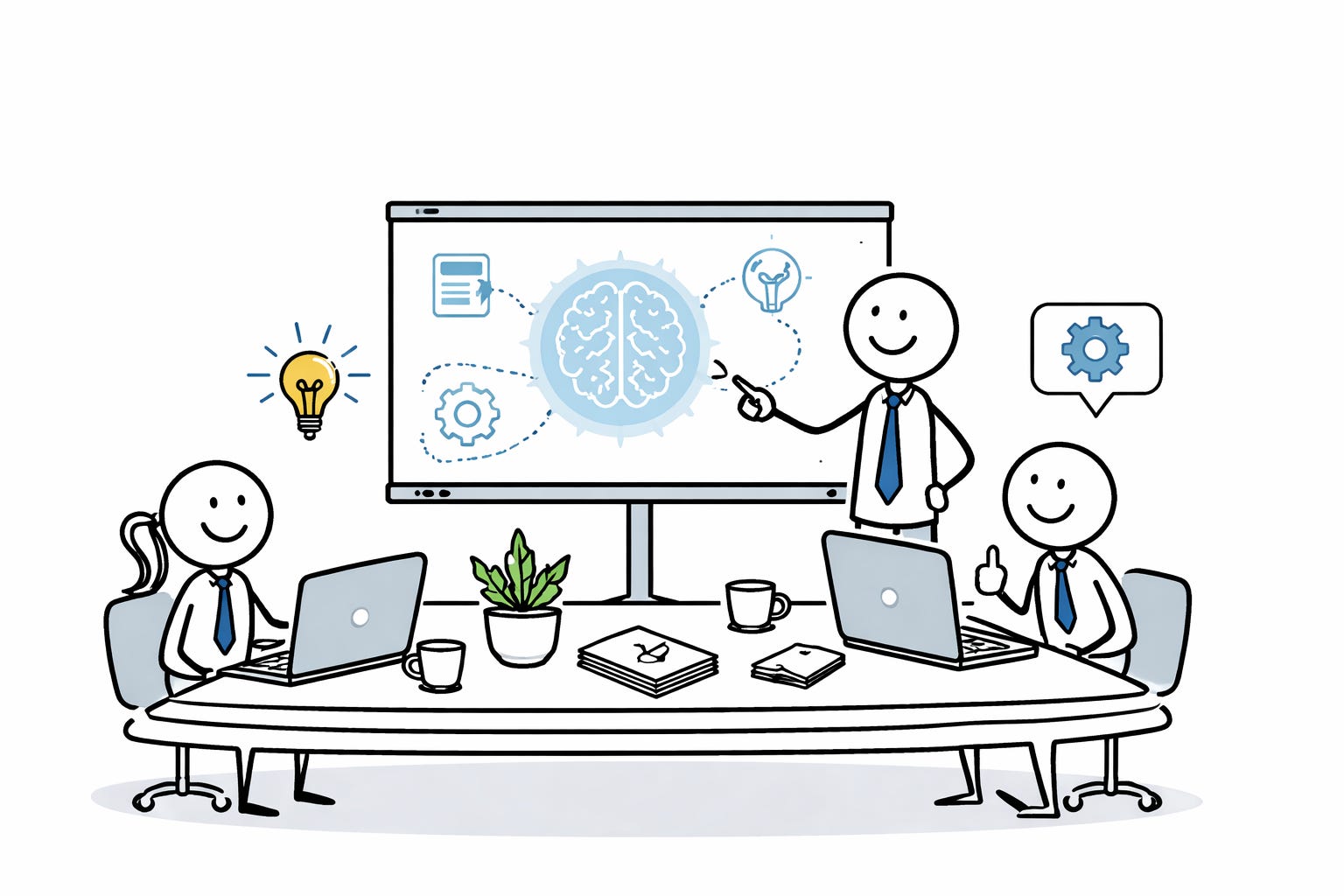
Successful AI adoption requires a combination of product strategy, infrastructure, governance, cross-functional leadership, and clear business value. Companies must also carefully balance innovation with responsibility, ensuring AI systems are safe, secure, and aligned with societal expectations.
Ultimately, AI transformation is not a single department initiative—it is an organization-wide shift that must be driven from the top leadership level and implemented across every function.
Disclaimer:
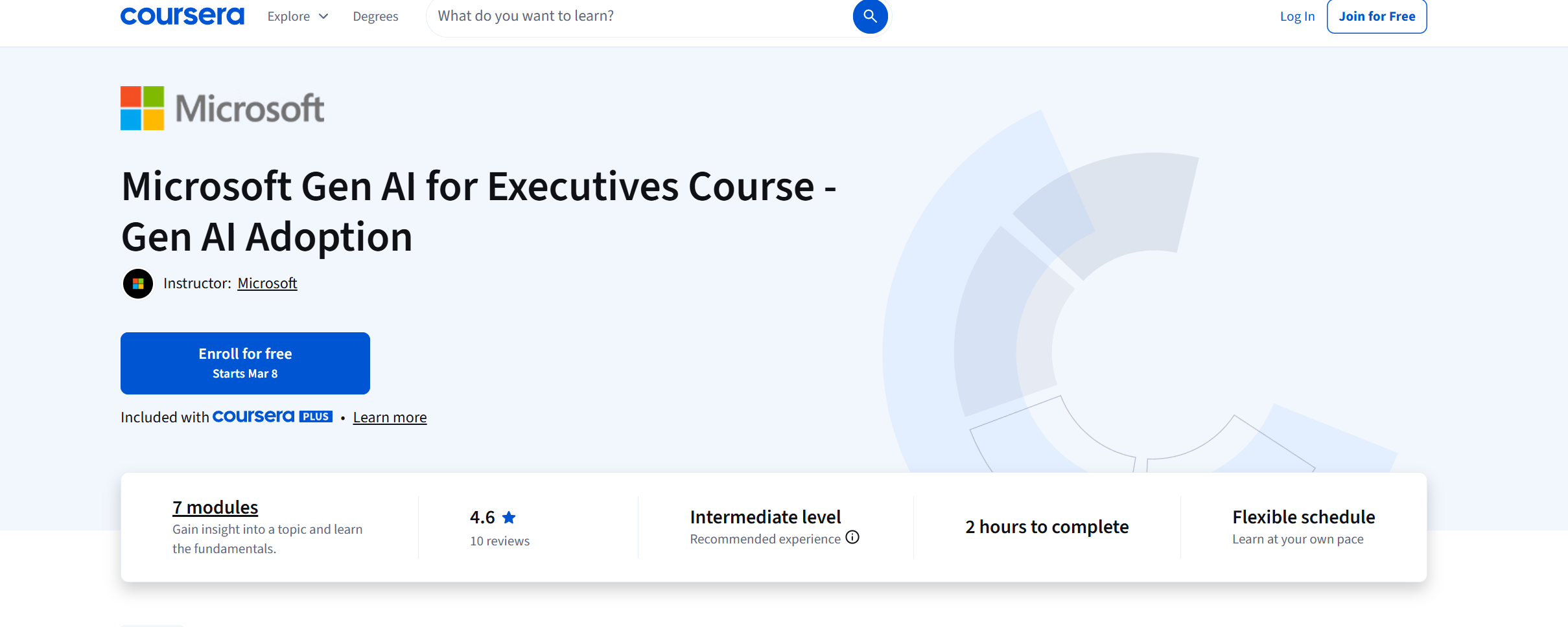
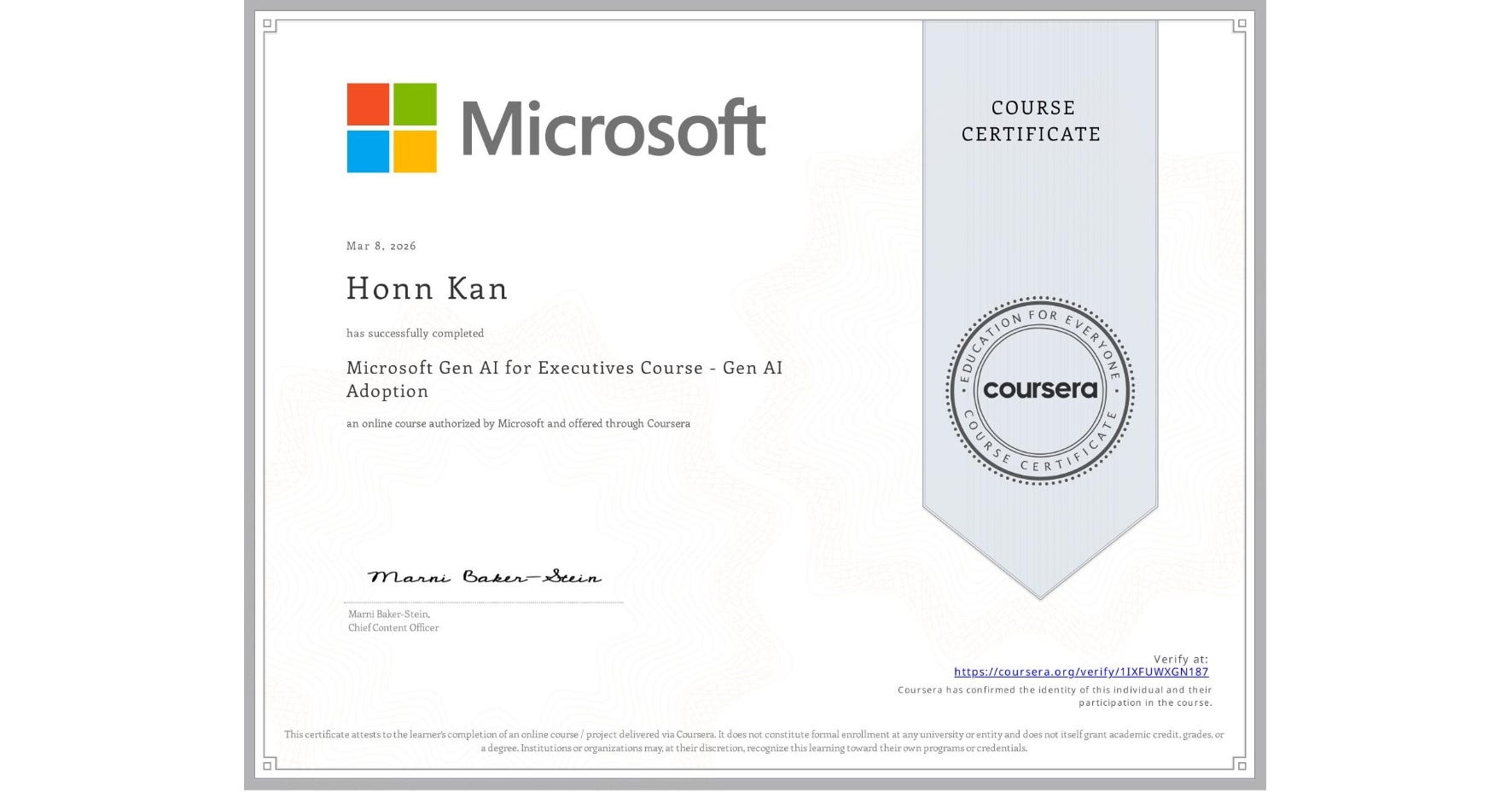
This content is a personal summary of insights from the Microsoft Gen AI for Executives course. It is based on my interpretation and learning experience and should not be considered an official summary or representation of Microsoft or the course instructors.
Enroll full programme here (Coursera)
Generative AI Is Not a Tool Upgrade. It Is a Company-Wide Operating Shift.
I break down high-level sales, marketing and AI implementation using real case studies and research.
Subscribe for sharp weekly insights you can actually apply to your company. 👇
According to Fatima Kardar, Microsoft’s Corporate Vice President for AI Infrastructure and AI Partnerships, the companies that will get the most value from GenAI are not the ones asking, “Where can we add AI?”
They are the ones asking:
What hard problem, product category, or workflow should be redesigned now that AI makes new things possible?
That shift in thinking is what separates experimentation from strategy.
KEY STRATEGIC INSIGHTS
1. Start with the hardest problem, not the easiest one
One of the strongest ideas in the lecture is that leaders should begin with the problem that used to feel unsolvable.
That matters because GenAI is not a cheap, lightweight tool. It is powerful, but it is also expensive and complex. If you use a powerful technology on a tiny problem, you often get a poor strategic return.
The better executive question is:
Where does our business have a difficult, high-friction, high-cost problem that traditional tools have not solved well?
This could be:
sales redesign
knowledge work automation
support transformation
internal research workflows
product experience redesign
company-wide search and decision support
The point is not to look for “an AI use case.”
The point is to look for a business bottleneck worth transforming.
2. GenAI changes the front end of work, not just the back end
Another major insight is that AI is not just about replacing a backend engine.
It changes how users interact with software.
Traditional software is built around buttons, menus, forms, and dashboards. Generative AI introduces a different interaction model: natural language, copilots, assistants, and conversational flows.
That means leaders need to stop asking only:
“Can we automate this process?”
And start asking:
“Should this entire user experience now work differently because AI exists?”
This is a product strategy issue, not just a tech issue.
3. GenAI is a power tool, so it needs a value test
Fatima uses a useful analogy: GenAI is a power tool.
That means it is powerful, but it is not always the right choice.
If all you need is a screwdriver, do not use a power drill.
This matters because many AI initiatives look exciting in prototype stage but become weak business ideas once leaders confront:
model cost
serving cost
latency
reliability issues
governance requirements
unclear ROI
The lecture repeatedly emphasizes that leaders must think in business terms:
What is the value created?
Who experiences that value?
What is the monetization model?
Can the business support the cost structure?
This is a critical executive filter.
GenAI excitement without economic logic is not strategy.
4. AI products require a full stack, not just a model
A key lesson from Bing Chat is that launching a GenAI product takes far more than access to GPT-4.
Microsoft had to build around the model:
responsible AI mechanisms
hallucination mitigation
orchestration systems
infrastructure at scale
safety processes
platform capabilities
monitoring and iteration loops
This is one of the most important points in the whole lecture.
Many leaders still think AI adoption means “plug in a model.”
Microsoft’s experience says otherwise.
The real challenge is not just model access.
The real challenge is building the product, platform, safety, and operating system around the model.
5. Centralized platforms beat fragmented AI efforts
Microsoft learned early that it was inefficient for every product team to build its own Copilot stack from scratch.
That led to an important strategic decision: build one common Copilot platform and let teams build on top of it.
This prevented:
duplicated work
inconsistent security practices
fragmented responsible AI controls
slower learning across teams
This has a huge implication for enterprise leaders.
If every department builds AI separately, the company gets scattered innovation, higher cost, and inconsistent governance.
If the company builds shared AI infrastructure, shared safety standards, and shared tooling, it moves faster and smarter.
6. AI transformation requires a true C-suite effort
This lecture repeatedly shows that successful GenAI adoption is not a CTO-only project.
At Microsoft, different leaders played different roles:
the CEO set the vision and urgency
the CTO helped identify the long-term technological shift
the CFO had to engage because AI is capital intensive
legal and policy leaders handled responsibility and risk
product leaders shaped the customer experience
infrastructure leaders ensured scale and capacity
This is what makes AI different from many past digital initiatives.
It is not simply “an IT rollout.”
It touches:
capital allocation
talent
compliance
product strategy
go-to-market
operations
trust
That means fragmented leadership leads to fragmented execution.
7. AI transformation is also a communication challenge
One of the best sections in the lecture is not about technology at all.
It is about communication.
When companies announce a major AI direction, employees immediately start wondering:
Am I still relevant?
Do I have the skills?
Is my department included?
Are we all moving in the same direction?
Is leadership being honest about what they know and don’t know?
Microsoft’s answer was not just more messaging.
It was contextual, repeated, transparent communication.
That means:
leadership repeats the same direction consistently
each function translates the message for its own context
employees get a clear role in the broader mission
leaders openly admit uncertainty where uncertainty exists
This is not soft stuff.
This is execution infrastructure.
Without it, even strong AI strategy breaks down in confusion, fear, and scattered effort.
8. AI adoption succeeds when people feel included, not replaced
One of the strongest cultural messages in the lecture is that Microsoft framed AI as a copilot, not an employee replacement story.
That framing matters.
The lecture acknowledges that AI will affect jobs. But the strategic posture is clear: the goal is not simply to remove people. The goal is to increase productivity and elevate the level of work humans do.
For example, GitHub Copilot helps developers spend less time on repetitive coding tasks and more time on higher-level architecture and problem solving.
That creates a better internal adoption narrative:
AI is here to assist, amplify, and accelerate.
If leaders fail to frame this clearly, internal resistance becomes inevitable.
9. Responsible AI is not a compliance checkbox
Another major executive lesson is that responsible AI has to be embedded from the beginning.
Not after launch.
Not after PR backlash.
Not after a security incident.
The lecture highlights multiple dimensions of responsible AI:
bias
fairness
hallucinations
misinformation
harmful outputs
data trust
enterprise safety
societal impact
Microsoft’s approach is multidisciplinary. It involves:
engineers
applied scientists
legal and policy experts
ethicists
psychologists
philosophers
researchers
diverse perspectives across regions and backgrounds
This is a powerful point for leaders.
If your AI governance process only includes technical people, it is incomplete.
10. Red teaming is not optional in AI
The lecture and supporting reading make a strong case for AI red teaming.
This is more than traditional security testing.
AI red teaming includes probing for:
security vulnerabilities
harmful content generation
bias
jailbreak attempts
prompt injection
ungrounded outputs
system misuse by both malicious and ordinary users
This is especially important because generative AI is probabilistic. The same prompt may not fail every time. That means testing has to be repeated, monitored, and treated as an ongoing discipline.
For executives, this means one thing:
AI risk cannot be governed once. It must be governed continuously.
BUSINESS APPLICATION
Marketing
Marketing teams can use GenAI for more than content volume.
The strategic opportunity is better message generation, better audience understanding, better campaign variation, faster testing, and better storytelling.
The lecture also hints at another use: using AI earlier in the creative process to support ideation, positioning, and narrative development.
That is important.
The real leverage is not just writing faster.
It is thinking better and shipping faster.
Operations
Operations teams can apply GenAI in incident management, reporting, internal workflows, and support systems.
Microsoft’s internal infrastructure work and the example of TaskWeaver show that operational AI can start as an internal tool before becoming a broader platform or product opportunity.
This is a valuable executive lens:
Some of your best AI products may begin as internal productivity systems.
Product
Product leaders should pay attention to the lecture’s biggest product lesson:
Do not bolt AI onto an old interface if AI should fundamentally change the experience.
This applies to:
search
internal knowledge tools
enterprise software
support systems
writing tools
coding tools
planning tools
GenAI often creates a chance to redesign the experience itself.
Management
Management teams need to treat AI as a coordination challenge.
That includes:
fast decision forums
clarity of ownership
visible leadership sponsorship
shared learning channels
training resources
centralized information hubs
internal alignment mechanisms
Microsoft’s “single point of truth” approach is especially practical here. Their internal “Era of AI” site was not important because it was a website. It was important because it created shared direction.
AI transformation
The full transformation lesson is this:
AI adoption requires a combination of:
strategic ambition
cost realism
platform thinking
communication discipline
people enablement
cross-functional leadership
continuous governance
That is the executive blueprint.
FRAMEWORKS / MODELS MENTIONED
Hard Problem First
Apply GenAI where traditional methods struggled most and where productivity upside is largest.
Copilot Model
AI should support human judgment and execution rather than fully replace the human operator.
Shared Platform Model
Create a common AI platform across teams instead of letting each team build its own stack.
One Company Alignment Model
Major AI moves require coordinated leadership across product, finance, legal, infrastructure, and operations.
Contextual and Repeated Communication
Leaders should repeat the same strategic message in different forms for different functions.
Responsible AI by Design
Safety, trust, and governance should begin at the start of development, not at the end.
AI Red Teaming
Use structured adversarial testing to expose security, safety, bias, and misuse risks before and after launch.
IMPORTANT DEFINITIONS
Generative AI
AI systems that generate text, code, images, or other outputs from prompts.
Copilot
An AI assistant designed to help a human work faster or better while keeping the human in control.
Hallucination
When an AI system produces information that sounds plausible but is inaccurate or fabricated.
Responsible AI
The practice of building AI systems with fairness, safety, privacy, transparency, and accountability in mind.
Red Teaming
The practice of intentionally probing systems to find weaknesses, risks, blind spots, or harmful failure modes.
Prompt Injection
A technique that attempts to manipulate an AI system by inserting malicious or misleading instructions into its inputs.
Jailbreaking
Attempts to bypass an AI system’s restrictions or safeguards.
Defense in Depth
A layered security and safety approach where multiple protections work together rather than relying on one safeguard.
REAL WORLD EXAMPLES
Bing Chat
Microsoft’s first large-scale GenAI product showed that shipping AI requires more than a model. It required infrastructure, safety layers, responsible AI reviews, platform orchestration, and ongoing hardening.
Shared Copilot Platform
After learning from Bing Chat, Microsoft decided not to let every team build AI infrastructure separately. Instead, it built a common Copilot platform.
GitHub Copilot
Used as an example of AI as productivity augmentation. Developers remain in control while repetitive tasks are accelerated.
TaskWeaver
An internal tool built for infrastructure and operational work that later became open source, showing how internal AI tools can become broader assets.
Internal “Era of AI” site
A centralized internal knowledge hub created to provide employees with a single source of truth about AI strategy, learning resources, APIs, tools, and direction.
Responsible AI review structures
Microsoft references its Office of Responsible AI, research boards, and Digital Safety Board as part of its governance model before shipping GenAI products.
ACTIONABLE EXECUTIVE TAKEAWAYS
1. Pick one hard, expensive, high-friction business problem
Do not start with a novelty use case. Start where improved productivity or better decision-making would meaningfully change the business.
2. Evaluate AI as a business model decision, not just a technology decision
Before approving a GenAI initiative, ask what value is created, who experiences it, and whether the economics work.
3. Build shared AI capabilities instead of scattered pilots
Create common tooling, common guardrails, and common standards so teams can move faster without duplicating effort.
4. Make AI transformation a true leadership agenda
Do not leave it inside one department. Finance, legal, product, infrastructure, and HR all need visible roles.
5. Communicate more than you think is necessary
Repeat the vision. Translate it by function. Admit uncertainty. Give people a clear role in the change.
6. Invest in employee readiness early
Training, skill development, access to tools, and practical learning paths are critical if you want adoption instead of fear.
7. Treat responsible AI as part of product quality
Bias, hallucinations, harmful outputs, and trust failures are not side issues. They are core product issues.
8. Build ongoing red teaming and monitoring into operations
AI systems evolve, user behavior changes, and new attack patterns emerge. Governance has to be continuous.
QUOTE-WORTHY INSIGHTS
“Start with the problem that was considered unsolvable until now.”
“Generative AI is a power tool.”
“This is not about just replacing the engine underneath. It is about changing the user experience.”
“If every team builds from the ground up, it is a waste of resources.”
“This AI transformation requires everybody to come together.”
“You have to say the same thing again and again and again in different manners.”
“The copilot is very purposeful. You are in charge and this is helping you.”
“With great power comes great responsibility.”
WHY THIS MATTERS FOR EXECUTIVES RIGHT NOW
Most companies are still in the experimentation stage of AI.
They are testing prompts.
Trying copilots.
Running isolated pilots.
Watching competitors.
But this lecture shows what mature thinking actually looks like.
Mature AI strategy is not:
random pilots
tool-first thinking
hype-driven use cases
isolated innovation teams
Mature AI strategy is:
problem-first
value-first
platform-based
leadership-led
communication-heavy
people-aware
governance-built
That is the difference between “using AI” and actually building an AI-ready company.
YOU NEED TO KNOW
What is the best way for executives to adopt generative AI?
The best way is to begin with high-value, complex business problems, align the C-suite, build shared platforms, train employees, and embed responsible AI and red teaming into the operating model.
Why should leaders avoid small GenAI use cases first?
Because GenAI is powerful but expensive. Small or incremental use cases often fail to justify the cost, complexity, and organizational effort required.
How does generative AI change product strategy?
It changes the interaction model from menus and workflows toward copilots, assistants, and natural language interfaces. That means product teams may need to redesign the experience, not just add a feature.
Why is C-suite collaboration important in GenAI adoption?
Because AI affects capital spending, compliance, talent, infrastructure, product design, and trust. No single function can manage it alone.
What is responsible AI in enterprise adoption?
Responsible AI means building systems that are safe, fair, secure, transparent, and governed appropriately before and after launch.
What is AI red teaming?
AI red teaming is structured testing designed to uncover security flaws, harmful outputs, jailbreak risks, prompt injection vulnerabilities, and other AI failure modes.